The price of admission: how Balboa Park’s parking fees are driving out locals and visitors
By: Kylie James
Story Highlights:
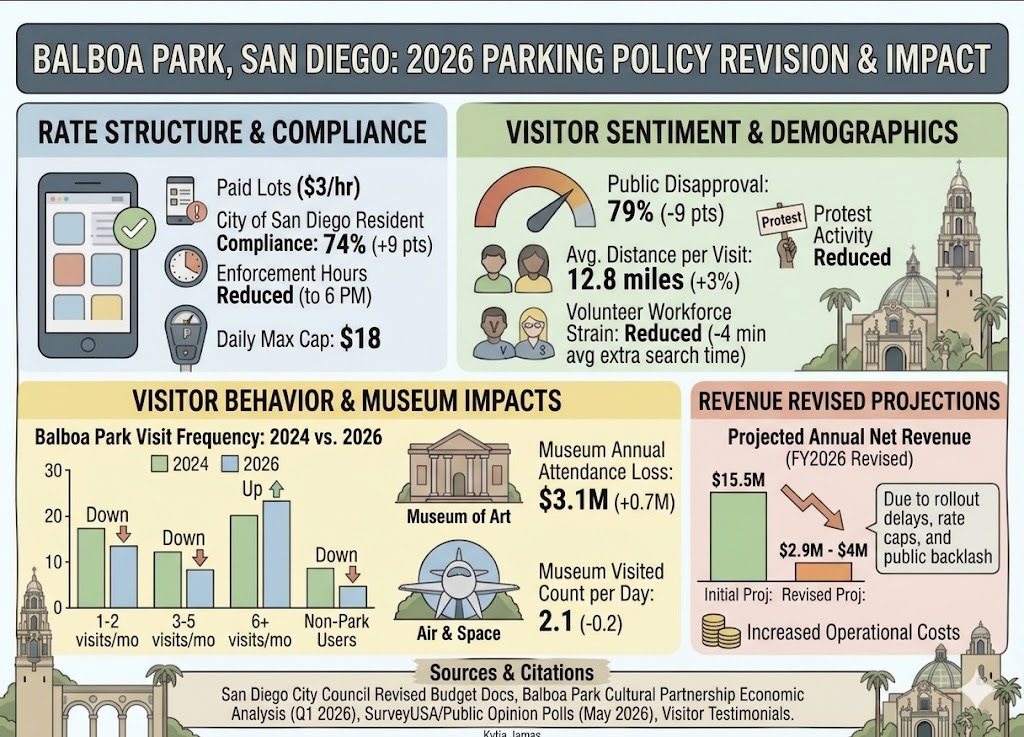
1. The "Death Spiral": Balboa Park institutions report a 25% to 38% drop in visitation since fees were implemented, threatening the educational programming and cultural health of the park’s most iconic museums.
2. A fiscal misfire: Despite projections of up to $15.5 million, actual parking revenue is now estimated as low as $2.9 million, leaving a significant budget hole and creating claims of mismanagement within the City Council.
3. The Volunteer issue: Along with the decrease in visitors, the "paywall" has forced 10% of volunteers to resign from nonprofits like the Automotive Museum, stripping these organizations of vital free labor.
SAN DIEGO — Balboa Park is known as the democratic heart of San Diego; a place where the only "entry fee" was the time it took to find a parking spot. But that legacy was shattered in January of 2026, when the City of San Diego ended a hundred-year tradition of free parking.
What was marketed by Mayor Todd Gloria’s administration as a necessary "revenue generator" to fix budget holes has instead become a fiscal and cultural downfall, driving away visitors and decreasing the value of the park's iconic institutions.
“It’s now incumbent on all of us to ensure it delivers so we can avoid steep and painful midyear cuts,” Gloria said, referring to the potential hits to the library system and recreation centers.
Recent data and polling has shown an immediate impact. Weeks after the fees were implemented, the Balboa Park Cultural Partnership reported a 25% drop in local resident visits across its 24 member organizations. Some museums, like the San Diego Automotive Museum, saw headcounts drop by as much as 38%.
"The paid parking program is eroding public trust and destabilizing the very institutions that bring the park to life," Peter Comiskey, Executive Director of the Partnership said.
He warned that the park is entering a "death spiral" where declining attendance leads to reduced revenue, which in turn forces cuts to the very programming that makes the park world-class.
Judy Gradwohl, President of the San Diego Natural History Museum, shared this concern, noting that if the trend continues, “[it’s] going to significantly affect our ability to produce educational programs.”
The impact isn't limited to locals. While tourists are often more accustomed to paying for parking, the confusion and "nickel-and-diming" atmosphere are already impacting the visitor experience.
Despite the new fees, the city’s parking revenue is now estimated at just $2.9 million to $3.7 million, a dramatic decrease from the original $11 million to $15.5 million projections.
The drop in park attendance coincides with a nearly 2% dip in hotel tax revenues, signaling that the "Crown Jewel" may be losing its appeal for out-of-town guests.
Additionally, the San Diego Automotive Museum reported that 10% of its volunteers quit specifically because of the parking costs, stripping nonprofits of the free labor they need to survive.
Museum CEO Lenny Lazinski noted that some long-term volunteers told him, “I’m too old to park as far away as they’re having us park.”
Facing a "veto-proof" majority of a City Council ready to remove the fees entirely, Mayor Gloria announced a partial rollback in early February of 2026.
The new plan, which took effect March 2nd, offers free parking in "Level 2" lots like Inspiration Point for verified city residents. However, critics argue this is a "shell game" that does little to help tourism or businesses. The premium "Level 1" lots closest to the museums remain paid for everyone, with residents still paying $8 per day.
The non-resident penalty includes tourists and San Diego County residents. Those living just outside city limits in Chula Vista or El Cajon still face fees up to $16 per day. These visitors often feel alienated; as one advocate noted during a “Repeal the Fees” rally, county residents “pay both property tax and sales tax... but when they visit what they consider to be ‘their’ park, they are treated like ‘tourists.’”
The "verification" system for residents has been full of technical glitches. The Falconer reported that residents were frustrated by an online portal that requires a $5 fee just to register and a two-day approval wait, leading many to just stay home.
The overarching sentiment among community members is one of betrayal. By placing a paywall around a public asset, the city has made it harder to access the arts.
“So many of the exhibits are free, it's a shame to make parking costs,” SDSU student Caden Mays said.
As the city continues to deal with an increasing budget deficit, whether or not the revenue gained from these meters is worth the long-term damage to San Diego’s cultural identity remains uncertain.
For the museums reporting empty halls and the families now priced out of their weekend tradition, the answer is a resounding no.